The Middle of the Road

A few years ago, I started out doing research on North Carolina basketball, but now I’m a legitimate fan of the program that the late, great Dean Smith made into a basketball juggernaut and eventually, a national brand. My deep dive into the program introduced me to so many legendary stories and it brought back quite a few high school memories. Few coaches have impacted the sport on the level Dean Smith (and Roy Williams to some degree) did both as a coach and an ambassador. I have always found inspiration in the positive ways that he touched so many lives.

Which is why it hurts to see how far the program has fallen. They are dangerously close to being perceived in similar light to programs such as UCLA and Indiana; two prominent college programs coasting on the accomplishments of the past. Although they are merely a season removed from being within one rebound of a national championship, I get the sense the program is trending in the wrong direction. In my opinion, the administration did not set Hubert Davis up to be at his most successful as the next UNC head coach. Carolina is a Rolls Royce of a program and very few rational parents would give the keys of their classic Rolls Royce to a first time driver without at least some supervision.

In their desire to keep the next hire “in the UNC family”, there were few strong options to succeed the retiring Roy Williams. I’m surprised that the administration would hire a first time head coach without also hiring an older, veteran consultant on the bench beside Hubert Davis. In the NBA, Steve Kerr had Alvin Gentry, Ron Adams, and Mike Brown. Phil Jackson had Tex Winter. Penny Hardaway had North Carolina’s very own Larry Brown. I think this would’ve mitigated (to some degree) any unnecessary turbulence that Coach Davis and the team experienced early on.

While Coach Davis should get a pass for the many missteps that first head coaches deal with, it is a bit baffling that Davis had a direct pipeline to two of the greatest to ever hold a clipboard, but yet; decided to go in a different direction stylistically. Coach Smith won 879 games playing with 2 big rebounders, fast breaking and secondary breaking, while Coach Roy Williams won over 400 games at both Kansas and UNC playing the same way. Coach Davis had the fortune of being in direct line of the Carolina blueprint, but it feels like he made his job harder than it has to be. Of all the coaches he played under and worked for, Davis adopting the style of Don Nelson’s gimmicky Nellie Ball (although fun at times to watch) has proven to be the least winningest approach to playing basketball.

One could argue that making the NCAA Final Four was in hindsight, fool’s gold (let’s be honest, they should’ve lost to Baylor), and that the 2022 season was full of red flags that weren’t as apparent because the team finished on such a hot streak. Many fans were quick to blame the players for last season’s rough ride, and some expressed a collective sigh of relief when multiple players left the program for various reasons. Although the players are responsible for playing defense, making baskets, and executing plays, the ultimate blame should lay on the coach. I for one, didn’t think Hubert Davis took enough accountability for last season’s results, and it feels like the media was a little too passive in their criticism of Coach Davis.

For instance, lets look at Coach Smith’s personal philosophy for coaching; detailed in his book, “Basketball: Multiple Offenses and Defenses.” Here are the tenets as follow:

1) Utilize personnel as effectively as possible

2) Encourage team play–achieve results through cooperation and unselfish effort on the part of every player.

3) Look to fast break at every opportunity

4) Concentrate on the high-percentage shot with good offensive rebounding coverage.

5) Multiple offense: Major emphasis on a free-lance offense, with rules along with some set offenses to make use of personnel.

6) Eliminate element of surprise by having team thoroughly prepared to meet all possible defenses.

7) Vary the offense throughout each game to prevent the defense from preparing too easily, or becoming accustomed a singular style of play.

When you look at these basic tenets of Coach Smith’s own philosophy and compare it with the last 2 seasons, it is easy to see the contrast in coaching philosophies. Coach Davis often looked like a chess player who refused to use all of his pieces, neglecting the station to station pieces in favor of his power pieces. He rarely subbed, and players rarely (if ever) gave the “tired signal” to come out of the game for even a minute. I think this is why they often seemed to wilt late into the 2nd half of games. Plays were not executed as crisply as they needed to be, players often looked lazy on defensive rotations and fighting through screens, and rebounds weren’t secured down the stretch, resulting in offensive teams retaining their possession.

Many fans saw this as laziness, or lack of desire, but to quote Jimmy Johnson, “fatigue makes cowards of us all.” Had Coach Davis trusted his bench more to play through their mistakes, there is a good chance that players would’ve showed more confidence in important moments down the stretch of conference play. Davis often said he wanted to employ a more NBA style of substitution patterns, but being a sub in the NBA differs from being a bench player in the college game. With only 40 minutes in the college game, there is less minutes available to share between positions, and it is extremely difficult to establish any sort of rhythm playing 4-5 minutes every 2 games or so. 18,19, and 20 year-olds need to play to learn how to play. It is completely different from being an adult and being a professional.

I also think that using his bench more would’ve allowed Davis to press more on defense. When the team was struggling to score points on offense, employing an occasional press could’ve kickstarted some fast break opportunities resulting in more easy baskets– or at least more foul shots. Creating 4 extra turnovers could have been the difference between getting their names called on Selection Sunday or turning down an NIT invitation. I often read that last year’s team just wasn’t that talented, and was a roster of non shooters; which may be true, but I also think the players weren’t utilized to their strengths (Coaches like Bill Self and Kelvin Sampson have often done more with less talent than Davis had last season).

Running a five out offense only works if you have Kevin Durant, Steph Curry, Klay Thompson, Draymond Green, and Andre Iguodala on the court (as many copycat NBA teams are finding out–shooting 30 3’s a game is already looking like a fad). Davis’ inability to adjust to his personnel cost the Tar Heels a chance to evaluate the players they already had, and showed potential recruits and transfers that Hubert Davis might be inflexible, and refuses to play his bench. There was a short period last season where the team looked like they were figuring things out (with Pete Nance out of the lineup and eventually coming on as a reserve) with a three guard lineup of Seth Trimble, R.J. Davis, and Caleb Love. The team looked quicker and the ball advanced down and around the court smoother with more fluidity, but this proved to be temporary.

Soon, Pete Nance was healthy again to start and the offense bogged down. A large contingent of fans wanted to put the majority of blame on Caleb Love, and although some of the criticism was deserved, he often got the ball with 5 seconds left and was expected to make a play. There was very little off the ball movement and the offense looked stagnant and unimaginative. Armando Bacot never developed much of a game away from the basket and his footwork in the post was often one dimensional. If we want to give Hubert Davis a pass for last season due to his team being limited, I am okay with that. What I am not okay with is the lack of adjustments both in game and in season.

I don’t give him a pass for the players not getting better down the stretch and showing improvement, and frankly, saying this team wasn’t that good implies that Coach Davis can only win when he has players better than everyone else (as opposed to Bill Self who can beat you with his or flip the teams and beat you with your own). And although most of last year’s team has left and a slew of transfers have come in , unless Hubert Davis makes some necessary coaching adjustments, next season will be one of being in the middle of the road (while further up that road Duke looks to flirt with yet another Final Four season).

With promising transfers from West Virginia (PF James Okonkwo), Louisville (forward Jae’Lyn Withers), Brown (guard Paxson Wojcik), Stanford (forward Harrison Ingram), and Notre Dame (guard Cormac Ryan) joining the team, and highly touted Elliot Cadeau looking to run point, Carolina should on paper, be better, stylistically and statistically. I also like the addition of former point guard, Marcus Paige to the bench as director of player development. Going forward, I also like the idea of the university hiring a general manager to alleviate Hubert Davis’ off the court duties (imagine had they had one of these back in 1998 when Coach Smith retired because he grew tired of all the duties not involved with coaching).

As of today, the team doesn’t have nearly enough front court depth. They lack a true backup for Armando Bacot, and they are thin at the 4 position (I’m curious how the team’s rebounding numbers will be next season). Let’s also remember how fragile starting lineups are. All it takes is an injury to a key starter to completely derail a team’s season. Come next March, we will see just how much Davis has learned from his first 2 seasons.

For better or worse, I think he will do just well enough to keep his job for the next two or three seasons. I think they will do well enough to make the tournament and then get knocked out the first or second weekend. My biggest fear for the program is UNC will be a school that instead of hanging Final Four banners, they will be known for raising banners for making the Sweet 16. Which is obviously great for other schools, but that is not the North Carolina standard that Coach Smith set and Coach Williams upheld. Sadly, it feels like that is the road they are heading towards: neither great nor awful, just fine–a nice program with a tremendous Hall of Fame museum. I hope that I’m wrong.

Bob E. Freeman

Before He was the GOAT: Excerpt from Tao of The Passing Big Man, and other Essays

The following is a chapter from my upcoming book, Tao of the Passing Big Man, and other essays. Due out if and when we survive this global pandemic. 


91sqa9davjl._ac_sx425_

“When I first saw Michael play, I recognized there was a different era coming in. In my time, I believe the best all around player has been Magic Johnson. The best defensive player has been Michael Cooper. And in a few more years Michael Jordan will be the best player there ever was.”

Larry Bird excerpt from his autobiography, “Drive”

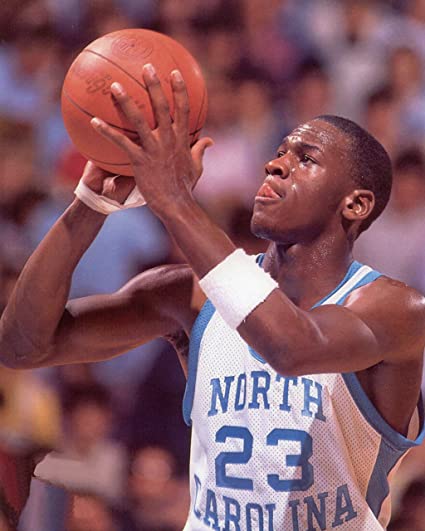
Even though Michael Jordan spent his final two seasons playing for the Washington Wizards, many fans’ lasting impression of number 23 is his jump shot over Bryon Russell as a Chicago Bull. It is easy to get blinded by the flashy dunks and dizzying highlights. Sure MJ had the Gatorade commercials, and the Nike and McDonald’s advertisements because he was such an exciting player to watch, but the reason Michael Jordan is held in such high reverence is because he really was the “Greatest of All Time”.

We can talk about his 6-0 record in the NBA Finals and six Finals MVP’s, his five regular season MVP’s, his ten scoring titles, and 14 All-Star appearances, but many people forget that he was also the best defensive player at his position. Jordan made First Team All-Defensive in nine of his seasons, led the league in steals three times, and during his 1988 campaign when he averaged 32 points per game, he was the defensive player of the year.

Before Michael Jordan’s ascent, the NBA was ruled by big men. Giants like Lew Alcindor, Bill Russell, and Wilt Chamberlain (and George Mikan before them) dominated the game. It was a conventional belief around the league that in order to win NBA titles consistently, you had to have a fixture at the center position to anchor your team. At 6’6, Jordan not only defied these conventions, he changed the league entirely; sparking the shift to a league full of wings and guards beating their defenders en route to gravity defying dunks.

Before he was hitting iconic game winning shots against Utah and Cleveland, he was hitting game winning jumpers to win NCAA games against Georgetown, Duke, NC State, and Maryland.

vcfcgr3y7bcsnkqzhyqbgzfqea

Jordan himself says that there would be no Michael Jordan without Dean Smith. Jordan says that after his parents, Dean Smith left the biggest imprint on who he became. Many ignorantly say that Dean Smith was the only man who could hold Jordan under 20 points, but he averaged 20 his sophomore year in college, and his junior year he hit 19.6 points per game (There was no shot clock or 3 point line back then either for what it is worth).


Early criticisms of Jordan’s NBA career was that he was a great scorer, but couldn’t get his teammates involved. Although this was warranted, looking back it was hard to blame him. Jordan had a better basketball coach, and better teammates (even better workout facilities) at Chapel Hill than he did during his early years in the NBA. At North Carolina, Jordan played with future Hall of Famer James Worthy (the 1982 NCAA Tourney Most Outstanding player with 28 points in the championship game on 13 of 17 shooting), Jimmy Black, Sam Perkins, Matt Doherty, Kenny Smith (2 time NBA Champion), and Brad Daugherty (5 time NBA All Star). 

At Carolina, Jordan had arguably most talent he’d ever play with in the 1982 and 1984 seasons, and his passing skills really showed– he almost always made the correct basketball play even back then. It was at North Carolina where he mastered the fundamentals of passing, rebounding, moving without the ball, and defending. Not only did Jordan have Dean Smith as his head coach, but during the Jordan era, Coach Smith had an impeccable roster of assistant coaches in Eddie Fogler, Roy Williams (the man credited with recruiting Jordan), and Bill Gutheridge.

The Media and today’s fans like to debate, who was the greatest MJ, Kobe, or Lebron like hip hop fans used to argue Biggie, Jay-Z, or Nas. But there is no debate. Kobe Bryant (R.I.P.) was a notorious ball hog (who was actually a really good passer when he wanted to be one) who could be goaded into taking a slew of bad shots under the right circumstances (shooting the Lakers out of the 2004 and 2008 Finals). Although Lebron will amass many gaudy stats and break a lot of records, many fans will point to his six losses in the NBA Finals, and proclivity to play “too passive” in key situations early on in his playoff career (we might be having an entirely different conversation today about Lebron if not for a historic collapse by the Golden State Warriors in 2016, and a Ray Allen clutch 3 pointer in 2013).

In short, Kobe may have been too selfish offensively and Lebron may not have been selfish enough. Michael (if I may be so bold to call him by his first name) was the perfect balance of the two, as one can point to his willingness to take over games when needed or make the game winning pass; as seen in the 1993 and 1997 Finals to John Paxson, and then Steve Kerr.

There was no weakness to Jordan’s game. He was a prolific scorer, a lockdown defender, and an underrated passer. He could drive to the basket and smack the ball into the defender’s face after posterizing them, or stop short and loft a floater in the lane, or he could just beat people by shooting over them from long distance.

Looking at both Lebron and Kobe’s careers, it makes you wonder what would their careers been like had they even played at least one year in college. Kobe would’ve played at Duke for Coach K, instead of Del Harris, and Lebron would’ve played for Thad Motta at Ohio State instead of the legendary Paul Silas. It seems petty to even speculate how much “better” two of the most elite players of their generations could’ve been (as I write this, I’m actually realizing that Kobe went to 7 NBA Finals in the span of a decade), but its necessary to illustrate the gap between those two first ballot HOF players and Michael Jeffrey Jordan.

It is a completely different conversation (for what it is worth, Kobe came pretty damn close) when you are talking about Jordan, and if you weren’t around to see him play in the 90’s then its not easy to understand. Statistics won’t tell the whole story about how truly dominant Jordan was and why he is is the elite among the elite. I think the biggest difference between Jordan, Kobe and Lebron, is that neither Lebron; nor Kobe had the tutelage of Dean Smith and Jordan did.

Jordan’s early development at the collegiate game was a direct testament to picking the right college and the right college coach in Dean Smith; who many consider the best teacher of the game in his time. Jordan most certainly would’ve still been the athletic freak that you see in his vintage highlight clips, but mentally and fundamentally, he may not have hit his apex had he gone to any other school in the country.

Former Tarheel, Kenny Smith, once said that “Michael Jordan was Dean Smith if Dean Smith still played basketball” and “that rarely do you see a player be the best athlete in a sport and be the most fundamentally sound.” Jordan was both. Oh yeah, (Kenny) Smith said that Jordan never took a bad shot. Think about that for a minute.

Quite often people reference the game winning jumper that Jordan hit during the 1982 championship game against Georgetown as if that told the whole story. Michael Jordan had 16 points on 7 of 13 shooting, but he also had 9 key rebounds, 2 steals and 2 steals. Even then, Jordan was focused on becoming a complete player. If he were just a scorer, he would’ve found it hard to even get off the bench during a championship game as a freshman, making it highly unlikely for a young player in that situation to find himself taking the game winning shot.

As for that game winning jumper, even Jordan admits that is when everything changed for him. He is quoted as saying “after that shot, he went from being Mike, to Michael Jordan”, and the rest as they say, is basketball history.

Screensho

Illustration by “Sweet” Lou Eastman


BM


profile pic b mick  Bobby Mickey is the alter ego of writer and poet Edward Austin Robertson. When he isn’t involved in some basketball related activity, actively looking for parties to deejay or venues to perform comedy, he can be found in the KDVS studios making on air playlists. For booking inquiries, send contact info to thisagoodassgame@gmail.com


Book Review: A Coach’s Life

You don’t have to go very far down the Dr. James Naismith coaching tree to find Dean Smith’s name. Coach Smith played for Dr. Phog Allen in the 50’s, as a sparsely used reserve on the 1952 and 1953 Final Four teams. They beat St. John’s for the title in 1952 and lost in 1953 to Indiana–incidentally it would be the St. John’s head coach, Frank McGuire who would change Smith’s life almost 10 years down the road, by hiring him as an assistant at Carolina.

I am hard pressed to think of a more sincere and heart warming memoir than the one I found in A Coach’s Life.  It is rife with history and lessons, and none of it comes off as pompous or self serving (the exact opposite of what I imagine a Coach K memoir to be like). Dean Smith touched a lot of lives and thought of himself more as a teacher than just a coach.

His practices were notoriously just as precise as John Wooden’s, and there was nothing frivolous about the drills implemented into a 2 hour practice. Everything was mapped out by time of the drill, duration of the drill and the emphasis of the drill. Before practice even began Smith would lay out the “thought for the day” as well as an “emphasis for the day.” Smith and his players were well prepared before the game even tipped off, and were ready for any situation to occur during game time. In his retelling of the 1993 Championship game, Smith talks about scouting Michigan after defensive rebounds, and how they set Michigan to use all their time outs before Chris Webber would make his infamous mistake near the end of the game.

It is a great book that not only talks about events, but the reader gets some insight into coaching in the NCAA and how college basketball changed over time. Coach Smith doles out some free philosophy that doesn’t come off as advice or browbeating. You can tell he really cared about using the game to teach young men about life, and that he really cared about his players. Jerry West once remarked that former UNC players had an allegiance to Dean Smith that was almost scary.

There is a lot of wisdom to glean from this book, as the reader follows Smith from Emporia to Topeka to Lawrence, and eventually to Chapel Hill. Smith lead a long and fruitful life that inspired everyone he came across to be better people. You’ll be hard pressed to find any of your favorite players or coaches who in some way weren’t indirectly affected by some of Dean Smith’s caching innovations.

Smith popularized the run and jump trapping defense, the fist as a tired signal, the four corners offense, timeouts after baskets (in the college game), pointing at the player who gave the scorer an assist, and believe it or not, wrist bands. The reason we see players huddling up during dead balls, is because Coach Smith wanted his players to discuss the next defensive play call. Smith’s basketball philosophy was that basketball was a team sport and that if a player wanted individual recognition then he “should play golf, tennis, or run track.” Sometimes he would make players play 1 on 5 during practice just to prove his point.

Coach Smith was the ultimate coach’s son. His father was his high school basketball coach, and his mother was a teacher. Smith lettered in high school as a catcher, a point guard, and a quarterback, which seemed to only groom him to be a leader someday.

Although Dean Smith reached 11 Final Fours, including 2 national titles, 23 straight NCAA appearances, and 13 straight Sweet Sixteen visits, Smith is most proud of his players’ accomplishments, saying that “Players win games and coaches lose them.”

Smith was more invested in building relationships and molding men than his win-loss record. His memoir made me consider what it really means to have a successful season as there are three seasons in college basketball: the regular season including conference play, the conference tournament, and the national tournaments (NIT,NCAA). Considering that Smith’s initial post season runs intersected with Coach John Wooden and UCLA, it lends some serious perspective–not everyone can be the national champion, and each victory must be appreciated on its own merits.

While he was a coach, the UNC basketball team had a 95 % graduation rate, and 26 of his former players went on to be first round NBA selections in the draft (one of them being some guy named Michael Jordan).  Even the players who went on to do other things in life besides play basketball, managed to become winners in life because of the time they spent learning from Dean Smith–becoming doctors, lawyers, and senators.

I checked out A Coach’s Life from the library, read it, returned it, and then went online an ordered a copy for my personal book collection. The book is an essential to anyone who one day wants to coach, or to anyone who just loves basketball. It is unquestionably a Who’s Who for the game, as anyone who was a student of the sport came across Dean Smith in some way or another. This book is easily an A +


BM


profile pic b mick  Bobby Mickey is the alter ego of writer and poet Edward Austin Robertson. When he isn’t involved in some basketball related activity, actively looking for parties to deejay or venues to perform comedy, he can be found recording podcasts with Craig Stein at Fullsass Studios. For booking inquiries, send contact info to thisagoodassgame@gmail.com


Mommy what is a Tar Heel?

Chapel Hill was dope.  Sometimes the spirit of competition and pageantry almost makes up for the hypocrisy of the NCAA and all that it represents. Chapel Hill is a must visit for any basketball aficionado, and if you go to Chapel Hill, then you may as well take the 15 minute car ride over to Durham. I spent a few hours in Dukieland (they’d lost to Virginia earlier that day) and got to see a very appropriate photography exhibit by Bill  Bamberger over at the Nasher museum on the Duke campus.

Two things worth checking out are the origins of the nickname Tar Heel and the bizarre and tragic history of the school’s various ram mascots.

The more I learn about the UNC basketball history the more it circles back to the University of Kansas. The more I learn about Michael Jordan the more things circle back to coaches Dean Smith and Roy Williams. I could spend a whole season in Chapel Hill gathering data about the role Tar Heel basketball played in the development of modern basketball. The state of North Carolina is rich in basketball history and thus, basketball is rich in North Carolina history. And if you’ve ever wondered what makes Michael Jordan the greatest ever basketball player in modern history (no disrespect to Lebron James), then just watch this series of videos I found on Youtube.

https://www.youtube.com/watch?v=RHdqi1J6mG0


https://www.youtube.com/watch?v=AYPM0Msnvnw


https://www.youtube.com/watch?v=VzxuW5vM60Y


profile pic b mick  Bobby Mickey is the alter ego of writer and poet Edward Austin Robertson. When he isn’t involved in some basketball related activity, actively looking for parties to deejay or venues to perform comedy, he can be found recording podcasts with Craig Stein at Fullsass Studios. For booking inquiries, send contact info to thisagoodassgame@gmail.com.