Westwood HO!!!

Despite my phobia for driving cars and displeasure for sitting in traffic, I took two trips out to Los Angeles to attend 2 Men’s basketball games at Pauley Pavilion; the December 10th game against the Michigan Wolverines, and again on January 21st; about a month later.

Los Angeles is the kind of city where neighborhood proximity pretty much dictate one’s social habits. Nothing illustrates this more than the location of USC, a little private school across town that you may or may not have heard of. Let’s just say that there aren’t an abundance of BMW dealerships, jewelry shops and banks in the surrounding neighborhood. Once you step off campus at USC you’re officially back in the real world. Trojans students and faculty work in a cocoon are in a world unto themselves, while UCLA is like more of a vacuum.

UCLA, a public university; is its own ecosystem, nestled within the exclusive section of town that is Beverly Hills. Westwood has its own choices of movie theatres, eateries (shout out to Fatburger) and banks to the point where its possible that a UCLA student to live in seclusion in relation to the rest of Los Angeles.

I made some rookie mistakes my first go around as a driver there. I didn’t give myself enough leeway and made it to the campus at exactly 7:00 PM for a 7:00 PM tip-off.  After paying for parking and jogging to the arena–located in the middle of campus, I had to wait in a yet another long ass line to get inside the frigging building (Los Angelinos are notorious for showing up to sporting events late, and now I understand why).

I typically go to sporting events early because I like to vibe the place out and watch the players get loose for the game. Driving in traffic for two hours and still being late, I walked in Pauley Pavillion irritated; rushing to sit down in my ticket section. The “Oohs” and “Ahhs”of the crowd tormented me with each passing second. I finally sat down in the 200 section (great seats) with the score already 12-14 and four minutes having ran off the clock.

That lesson prepared me for the second time around. I arrived on campus 1.5 hours ahead of the 1 pm tip-off. I had enough time to park, walk over to Kinross to grab a Fatburger, and walk back to Pauley. With about 30 mins until tip-off, I was surprised to find lines of no more than eight people. This only further proved the theory about people in L.A. unable to get anywhere on time.

***********************************************************************

You can feel the history within the  walls the very second that you enter Pauley Pavillion. Part of UCLA’s mystique is their long and storied history of producing champions and NBA players. You can’t talk about UCLA basketball without mentioning John Wooden, the legendary coach who went on to become one of the biggest ambassadors the game of basketball has ever had.

At UCLA, Wooden won 10 national titles–once with a run of 88 straight wins that lasted 3 seasons. Wooden, arguably the greatest college coach of all time, was known as much for his words of wisdom as he was for his coaching accomplishments. The man created what is known as the Pyramid of Success (there is model replica glass display in the arena concourse), a chain of philosophical guidelines that he used to help his players. John Wooden was just as much of an instructor as he was a coach. His approach to the game was for his young men to learn the game within the game. He insisted that the true opponent was an internal one and that the only result that mattered was that one played their personal best.

At the program’s peak, many legendary players passed through Westwood. Men such as Jamaal Wilkes, Kareem Abdul Jabbaar, Walt Hazzard, Marques Johnson, Bill Walton, Baron Davis, Gail Goodrich, Sydney Wicks, and Henry Bibby (father of future Wildcat great Mike Bibby) all won under the tutelage of John Wooden.

What I liked most about Pauley Pavillion was the way they’ve meticulously preserved remnants from each era of UCLA basketball. You’re just as likely to run into a banner commemorating Matt Barnes or Reggie Miller as you would a plaque with the image of Bill Walton or Lew Alcindor.

Both games I found myself swept up in the mirth and excitement. The arena is well lit with hardly a bad location among the 13,000 plus seats. The court sports a classically simple design, displaying the blue and gold UCLA letters in cursive at half court. There is a bigger than usual student section from both behind one of the baskets and along the sideline opposite the bench. The band loudly and proudly played the UCLA fight song and the crowd took direction from the cheer team U!!! C!!!! L!!!! A!!!!!!!

I’ve gone off before about how beautiful the UCLA cheerleaders are (they look like grown ass women. One pair of beauties passed me in the concourse at the Zona game. I geeked out for a brief second before I remembering that  I was 40 yrs old.), but what equally impresses me are the complexity of their routines. I suspect that these young ladies are dancing as if they are auditioning for the Lakers dance team (in L.A. you never know who could be in the stands). Makes you wonder what the future holds for some of these young ladies. I would believe any scenario thrown out there: Doctor, lawyer, NBA dancer, Playboy Bunny, reality housewife, porno star–the whole spectrum comes into play.

8db181be932a9a8fa8cf3df36e2469c0-image-1000x667

UCLA fans, both young and old, proudly wore their blue and gold strolling the concourse, looking for the nearest restroom or vendor stand. I passed many older fans for whom it was obvious that they’d had season tickets for generations. Los Angeles is a huge city full of transplants so it shouldn’t have surprised me (but it did) to see so many Arizona and Michigan fans/alums in the crowd at these games. These fans would manage to find their voices during the other teams’ runs, but would always eventually get drowned out by the chorus of “UCLA” chants.

The game against Arizona was  Kareem Abdul-Jabbar Day at UCLA, and he spoke to the crowd at halftime. Jabbar was honored for winning the Presidential Medal of Freedom. I got chills being in the same building as one of the greatest basketball champions of all time. He was greeted with applause as he was escorted to his courtside seat–everyone instinctively stood in reverence to such basketball royalty.
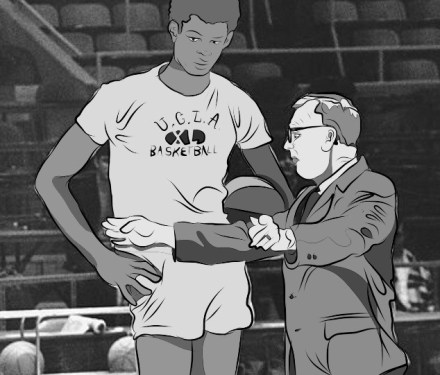
image1-9

Illustration by Louis Eastman

There has been a buzz surrounding the squad this year. They have been a top 10 team all season; which explains the electricity floating in the Westwood air–and its not just the drones and cell phone towers.

The team consistently won during Ben Howland era. UCLA went to three Final Fours under Howland and put a slew of pro players into the NBA, but even with future superstars like Russell Westbrook and Kevin Love, their wins were from a “grind it out,” Big East style of play. They weren’t exactly a fun team to watch.

This current outfit that head coach Steve Alford is in charge of handling is easily the most exciting team since the mid-90’s Tyus Edney/Ed Obannon/Toby Bailey Bruins teams.  The up and down style of play of those teams was frenetic and above the rim (they gave the Fab Five all they could handle during the 93 NCAA tournament). I imagine their exciting run would have been even longer had they given a scholarship to local high school phenom Paul Pierce rather than center Jelani McCoy (who to be fair wasn’t a bad player, but he was no Paul Pierce)–Pierce grew up in Inglewood and wanted to play for the Bruins (I just lost my mind for a second spacing out on a 1997 alternate reality with Paul Pierce catching oops from Baron Davis and vice versa. WOW!!!!!).

Aside Note: Speaking of Baron Davis, he was in attendance at the Michigan game. Bruins games have their own version of “celebrity row” with the arena cameras zooming in on the faces of Peter Dante and “Hills Street Blues” legend Mike Warren. I was secretly hoping to run into Jalen Rose at the game, but my tardiness erased any expectations that I had concerning the game. If he was there, I didn’t see him on the Jumbotron.

NCAA Basketball: Oregon at UCLA

***********************************************************************

Coach Alford employs a run and gun system that emulates the Spurs and Warriors motion offenses. Seniors Isaac Hamilton and Bryce Alford (Steve’s son) anchor the team with their leadership while the youngsters, Aaron Holiday (brother of NBA guards Justin and Jrue) and freshman phenoms T.J. Leaf (who kind of reminds me of an 18 year old Nick Collison) and Lonzo Ball bring flash, height and speed for defenses to contend with. 

The team relies on defense and rebounding from big men, Ike Anigbogu, (had 4 really  impressive blocks in the Michigan game), and Thomas Welsh.

Pro scouts are drooling the most over Ball. When people say that he reminds them of Jason Kidd, I see it. He is a 6’6 light skinned point guard with incredible court vision. He is a better shooter than Jason Kidd was in college (he’s a threat to shoot it from nearly anywhere on the court), but I am not sure how the form on his shot will translate in the pros (perhaps he’ll find a shot doctor like Kawhi Leonard did in Chip Engelland).

The other night against Oregon, Ball hit a dagger three from deep behind the line that I’m almost certainly would have gotten blocked in the NBA. Though I wouldn’t get too caught up on his shooting form if I worked for any NBA team scouting him. Jason Kidd could barely shoot free throws when he first got to the league, but he ended his career in the top ten of all time 3 point shots made.

My only (albeit mild) critiques was that he tended to rely on his dribble too much sometimes and would get stuck in the air because he’d penetrated too far into the paint. Somehow he’d get bailed out with a spectacular pass to an open teammate, but again, the kind of passes that are spectacular in the college game become turnovers in the NBA against better athletes and defenders. He will be a lottery pick, as there is no reason for him to come back to school (other than playing with his younger brothers again). Any development he needs for the next level will have to be gained from on the job training.

UCLA is stacked with talent, but their perimeter defense is suspect. In their loss to Arizona,  the U of A guards, Kobi Simmons, Kadeem Allen and Allonzo Trier, got to the rack anytime they wanted AND when UCLA collapsed the paint, they kicked the ball out for someone to hit an open 3 pointer. Seven Wildcats players were in double figures and Kadeem Allen was only 1 point away from it being 8 players.

The Arizona game showed what can happen to the Bruins when they don’t make their 3 pointers and can’t get any points in the paint. I’m curious what happens in their rematch later this month (‘Zona may be the most balanced team in the county right now).

UCLA has the depth to go far in the tournament. They are fast and can get up and down the court, routinely scoring in the 100’s. Their downfall will be their defense however. At some  point this season the Bruins will need to make a crucial stop in a game. The question is will they be able to?

Either way, it is good to see UCLA basketball is exciting again. It is easy to be happy for these fans and I’m glad they have a reason to be excited. Nothing connects the fanbases of different eras more than winning and tradition, and you’ll find plenty of both at UCLA.

BM

profile pic b mick  Bobby Mickey is the alter ego of writer and poet Edward Austin Robertson. When he isn’t involved in some basketball related activity, actively looking for parties to deejay or venues to perform comedy, he can be found recording podcasts with Craig Stein at Fullsass Studios. Follow him on twitter @clickpicka79. For booking inquiries, send contact info to thisagoodassgame@gmail.com. 

The Teen Wolves Take Manhattan

I got chills walking up 8th avenue, and it wasn’t from the wind tunnels created by the Manhattan skyscrapers. Midtown was lit up with lights, traffic, and people; and Madison Square Garden was draped in a uniformly Knickerbocker blue and orange. Rightly or wrongly, New York City has been widely regarded as the “Mecca of basketball” and it would be disingenuous of me to write a book about basketball without attending a Knicks game.

Madison Square Garden has had its share of historical events. Moments from the 94 NHL Finals commemorate and decorate the arena walls. The once mighty Big East capped every regular season with a conference tournament; providing countless college basketball memories that held as much desperate intensity as the NCAA tournament. It never dawned on me that events like George Harrison’s Concert For Bangladesh, or the famed 9/11 music benefit took place at MSG.

The Garden’s luxurious and clean interior  (and ticket prices) evokes the decor of a high-end hotel. I did not see one piece of litter on its grounds (inside or out) and the staff was extremely courteous and polite. From a visual aspect, there is not a bad seat in the building, however; the seating areas are super cramped. There is zero leg room and I had no where to even put my jacket and notebook.  Lack of comfort aside; my seats were fine (I was fortuitously sandwiched between two attractive women–one an older Italian and the other a younger Eastern European) and I could see the whole court from the 200 level.

New Yorkers are not an easily impressed lot, so it was no surprise that the player introductions were such an elaborate production. A Knicks game is no different from any event you’ll see on Broadway. I can imagine the Knicks’ marketing department faces a pressure that can only be matched in cities like Chicago, Miami, and  Los Angeles where the game is only part of the entertainment package.

I’ve never attended an NBA game where the team was so generous with their team swag. They must’ve busted out the  T-shirt cannons every other full timeout. It was like they couldn’t give those t-shirts away fast enough. “You get a t-shirt! You get a t-shirt! YOU get a t-shirt!” It was kinda fun.

I especially liked the reoccurring Celebrity Row bit that happened at every timeout. This particular Friday night was a bit celebrity starved because they best “celebs” they could find were former Giants punter Sean Landetta (who got the second loudest applause), actors Ansel Elgert and Juan long,  Larry Wilmore, and Joe Budden (who got the loudest applause).

There was even a program on a Jumbotron where you could see who’d be performing during each timeout. I’d seen the Knicks City Dancers on television, but they were even more mesmerizing to watch in person. The dance choreographer put together some great numbers that were executed to perfection. I couldn’t help but think that having Knicks Dancer/choreographer on one’s resume has a certain cache attached to it (which then made me wonder if being an  In Living Color Fly Girl was something you did right before becoming a Laker cheerleader or vice versa but I digress). As of today, I will anoint the KCD’s as the best dance team in the NBA.

My only complaint was the halftime “entertainment” of musician Theo Katzman and his equally boring bandmates. Katzman’s uncle must have greased Knicks owner James Dolan’s palms, because I don’t see how someone could have sat through an audition by Theo without recognizing its  wackness. I took the opportunity to walk the arena concourse during his set.

**********************************************************************

The game itself was fun. Minnesota was in town and they have a few interesting players, but their roster shows very little direction as to what their goals are for the team. There were a ton of people ready to pencil them in for that 8th seed in the west just because the team had hired Tom Thibodeau. People are looking for all sort of excuse for why Minnesota isn’t playing well. My opinion is that Thibs was a bad fit and the team just isn’t that good.

I gotta say, I’m still not sold on coach Thibs as a head coach. It feels like he didn’t learn a thing from his stint in Chicago, and I’m worried that his style will grind down the bodies of  Andrew Wiggins, Karl Anthony-Towns, and company the same way he did to the Derrick Rose, Joakim Noah, and Luol Deng Bulls teams (look at the time on the clock during this infamous ACL injury).

For some reason, no one batted an eye when Timberwolves owner gave Thibodeau boatloads of money to be a head coach and GM (pretty sure Jeff Van Gundy, a proven teacher and ambassador for the sport, was available), even though he’s never had any front office experience. Now if a player has a problem with Thibs the coach, they  have to deal with Thibs the GM to resolve it. This misfire by Taylor may set the Timberwolves franchise back 3-5 years and undo all the progress that Flip Saunders worked so hard to create within the organization.

I can’t imagine going to work and having to hear his voice and see his face for the majority of the day. The guy barks non-stop and he has the perpetual expression of someone who hasn’t had a bowel movement in so long that their colon leapt into their upper stomach and just stayed there. He probably belongs in the college game as a head coach–though I wouldn’t send my kid to go to his school and be yelled at by him.

Minnesota needs to figure out what they want to do going forward. Zach Lavine is showing some promise, but he relies too much on his (erratic) 3 point shooting, and his decision-making is questionable at best (the only player he creates shots for is himself). It was smart to put Lavine at shooting guard position because he doesn’t have to facilitate the offense– but he isn’t that great of a shooter yet. I was big on him getting traded until I noticed his 2.24 million dollar salary– a steal for a player with his athleticism.

The biggest problem is that Minnesota has no veteran role players who can contribute on a larger scale. That is fine if they want to do just develop the young guys they already have, but to hear the way Thibs screams at them, you would think they wanna make a run at the playoffs. If that is indeed the case, they will need to make a trade (and that may not even be enough to make the top 8 in the west).

Ricky Rubio clearly needs out of Minneapolis, and Minnesota needs to move on from the Spanish point guard. Its been seven years since the 2009 draft and it is time to recognize Rubio for the kind of player he really is. He is Rajon Rondo light. He plays decent defense and is a good distributor, but he still can’t shoot, and he doesn’t finish at the rim consistently. I think the Timberwolves should see if Philly will bite on a trade for Nerlens Noel (a defensive big who doesn’t need to score), Ersan Iylasova, and Gerald Henderson. Maybe it takes Minnesota throwing in Brandon Rush and Jordan Hill (and a draft pick swap) to make it work, but it wouldn’t hurt to try.

At this point they need to see if Kris Dunn can play or not (He has a Chauncey Billups kind of swag about him–he has played okay in what little run he has gotten and he seems to be soaking in all the lessons the league has to offer a rookie) , and why waste a year with him on the bench, if  the team won’t make the playoffs anyway? If they don’t trade Rubio and he walks away for nothing, then they start next year with the same questions at the PG position possibly wasting another year from your superstar player’s careers. A Rubio trade would benefit both parties, T-Wolves get something in return and Rubio gets out of town. If he doesn’t like where he ends up, he can just play the year out before signing with Golden State next season as Steph Curry’s backup (imagine them on the court at the same time late in quarters).

The next 10 games for Minnesota may decide if they make a trade, or stand pat with what they have. If they go less than .500 over the next couple of weeks, you will probably see a deal made. Either way, it is already clear to me that they don’t have the horses to make a playoff run, and I doubt even a trade would be enough to make it a reality. I think every move made by the coach/front office should be made with next year in mind. Unfortunately I suspect that this collection of young talent will go the way of the “3 J’s” Dallas Mavericks and the 2011-2013 “RunOKC” Thunder.

***********************************************************************

The Knickerbockers have not made much progress from last season to this season. The Knicks won the game despite having poor floor spacing, terrible ball movement, and more bad shots than good shots. They have an okay nucleus of players that are just enough to get butts in the seats, but offensively they are an eyesore. I kept looking over in Phil Jackson’s direction trying to guess what he thought of such a putrid display.

I’m surprised Jeff Hornacek hasn’t explored the possibility of a Brandon Jennings and Derrick Rose backcourt. The team looked much better offensively when Jennings (who is a really fun player to watch in person) was on the floor, as he is a better shooter and distributor than (the not as explosive as he used to be) Rose; whose jump shot is still broke.

For all the crap that critics like to give Phil Jackson, the current personnel of this team may be best suited for the Triangle. Running P/R plays for Derrick Rose and Carmelo Anthony may work, but it doesn’t mean its the best option. This team has no clearly defined identity and the Triangle may be the best remedy for such an assortment of good, but not great players. My biggest disappointment from the game I attended was that Jeff Hornacek let the players like Kyle O’ Quinn and Brandon Jennings cool down on the bench after having really productive first halves. Jennings never got back in rhythm but O’Quinn managed to come back in at the right time and give the Knicks what they needed to win the game by grabbing timely rebounds and making big shots.

When I first sat down to my seat, I was concerned that the crowd would be your typical NBA crowd in a tourist city. For many fanbases, the diehard fans  get priced out of games, and this affects the fervency of the atmosphere. In other words, I though the crowd was lame. But then something happened, every time there was a hustle play, or the Knicks managed to get a 50-50 ball, or a big defensive stop, the crowd would roar in a way I’d only seen at Kansas Jayhawks home games. The fans cheered excitedly when they were supposed to and occasionally got super loud.

The familiar chants of “DEFENSE” in unison with the house organ took me back to the 90’s when I was a kid watching Knicks games on television. It gave me goosebumps. It sucks that they are so bad, because Knicks fans deserve a winning team and the NBA is a better league when the Knicks are relevant.

Win or lose, New York City fans really care about their teams (well maybe not the Nets, but I think they should be moved to Seattle). Knicks fans were constantly trolling anyone who made the mistake of wearing their Timberwolves gear (the best insult I heard was “your mother is a really nice woman………but your grandmother is a filthy whore.” This was a TIMBERWOLVES game!!).

As crass as they can be, I enjoy their passion and enthusiasm. Attending Knicks and Mets games have provided me with the type of special experiences that I haven’t felt in many places here in the U.S.A. (I’m convinced that New York is the last American city that I can see myself living) There is an authenticity to the NYC sporting events that is unique to only NYC. You never forget where you are the whole time you are at the Garden. It is one of the few arenas left in the league where the event itself takes a backseat to the arena.

BM

 profile pic b mick  Bobby Mickey is the alter ego of writer and poet Edward Austin Robertson. When he isn’t involved in some basketball related activity, actively looking for parties to deejay or venues to perform comedy, he can be found recording podcasts with Craig Stein at FullsassStudios. Follow him on twitter @clickpicka79. For booking inquiries, send contact info to thisagoodassgame@gmail.com

More Than A Game: A Book Review

Characteristics of a Sound Offense (According to Phil Jackson and Charley Rosen)

1. Must penetrate the defense.

      a)Create good % shots. Define what is a good shot for each player

      b) Stress inside power game. Play for the 3 pt. power play.

      c)Break down all defenses from full court presses to double teams.

2. Transition basketball starts on defense. Look to run!

3. Provides proper floor spacing 15’-18’, creating an operating room and clearing area on the court. Keeps defense occupied on and off the ball.

4.Provides player and ball movement with a purpose. There is only one ball and 5 players. All things being equal, a player is without the ball 80 % of the time.

5. Provides strong rebound position and good defensive balance on all good shot.

6.Provides the player with the ball an opportunity to pass to any of his teammates.Utilize the abilities of the individual players. Must create high % shots for a team’s best shooters, rebound opportunities for best drivers.


More Than A Game is as close to a philosophy book as you will find on the game of basketball. A coach is only as successful as their coaching philosophy. John Wooden had his Pyramid of Success, Don Nelson had Nellie-ball, which was about creating defensive mismatches by having the best five offensive players on the court at one time, and Tex Winters had the Triangle Offense (also called the Triple Post); which hit the peak of its success when Phil Jackson implemented it with the Chicago Bulls, and later with the Los Angeles Lakers.

Though some chapters are dedicated to filling in the gaps of the coauthor’s lives, the book doesn’t get bogged down in the “who, what, and why’s”. The narrative thread is seamless despite the jumps in place and time. The reader learns  about Jackson’s Knicks days and how he met Rosen during this time period.

Phil discusses his upbringing and the road that led him to him abandon the Pentecostal concepts of sinning, the afterlife, and redemption, for Zen Christianity (essentially trading in a belief in the otherworldly for something tangible and non-theistic). Jackson expresses how the attraction for the Triangle philosophy almost mirrors his personal religious aesthetic, as he recites the Noble Eightfold Path and how it relates to hoops:

  • Right Understanding
  • Right Thought
  • Right Speech
  • Right Action
  • Right Livelihood
  • Right Effort
  • Right Mindfulness
  • Right Concentration

Jackson goes on to further explain that “Right thought means being in the moment as much as humanly possible. Right action means playing every play, every quarter, every game to its fullest.Winning is only the secondary effect of right thinking and right action.”

Jackson embrace of the Triangle Offense came when he and Tex Winter were Bulls assistant coaches under Doug Collins. Jackson thought the Winter’s offensive scheme reminded him of his time playing for Red Holtzman (who Phil got to watch up close when he was on the bench with a back injury). When Phil was finally promoted to head coach (after Doug Collins’ dismissal), he kept Winter on as an assistant and let Winter install the offense that both credit for their coaching success. Why was it so successful? According to Phil Jackson:

  • Provides a clear purpose and direction with implicit goals.
  • Trains and educates new people, who in turn learn how they can contribute.
  • It rewards unselfish behavior which in turn renews the system.
  • Makes for easier transition through times of change.
  • Provides context within which a leader can integrate all the skills of the team.

The Bulls were able to win 6 titles despite not ever having a dominate point guard or center, and the Lakers managed to win multiple titles with a bunch of role players (some of them scrubs) filling the stat sheet with whatever Kobe Bryant and Shaquille O’Neal could not do themselves.

Some of the other highlights from this book are

  • Getting confirmation from both Charley Rosen and Phil Jackson that Rick Barry is indeed an asshole.
  • Jim Cleamons theory on why east coast bred players practice harder than west coast guys.
  • A scene with Phil, Charley, and Tex watching an instructional video by “Pistol” Pete Maravich and discussing the phenomenon of the palming violation.
  • Phil’s and Charley’s collective coaching experiences in the Puerto Rico Superior League and CBA.
  • Jim Cleamons and Quinn Buckner’s (separate) attempts to install the triple post offense as head coaches in Dallas, and the player reactions.
  • Despite Portland going 13 straight possessions without scoring, the Trailblazers lost not because they choked, but because they were gassed from coming back from a 3-1 deficit in the 1999-2000 conference finals.
  • The genesis of the triangle going all the way back to USC coach Sam Barry’s “Center Option with a reverse action” playbook.


Littered with hoops jargon and diagrams that illustrate the basic ways to fill a triangle; More Than a Game strikes a beautiful balance of real life experiences with  X’s and O’s. The symmetry of Jackson and Rosen’s storytelling reveals accuracy of the phrase “basketball is an expression of life.” Each experience is treated as merely another step on the path to basketball nirvana. This book is a must read for anyone who wants to go into coaching–basketball or otherwise. A+

BM


 profile pic b mick  Bobby Mickey is the alter ego of writer and poet Edward Austin Robertson. When he isn’t involved in some basketball related activity, actively looking for parties to deejay or venues to perform comedy, he can be found recording podcasts with Craig Stein at FullsassStudios. Follow him on twitter @clickpicka79. For booking inquiries, send contact info to thisagoodassgame@gmail.com


A Book Review of :07 Seconds or Less

If you’ve read Sports Illustrated or stumbled across the book Unfinished Business, then you are familiar with the work of Jack McCallum. Mccallum has been a notable figure in the sports journalism circles for decades as a basketball writer for SI, and his various paperback books about both basketball and non-basketball related topics. He is currently in the basketball Hall of Fame as a writer, and for any older school Celtics fans of the Parish,Bird, and McHale era should get their hands on Unfinished Business.

61zjdut9agl-_uy200_

Much like Unfinished Business, McCallum follows around the ’05-06 Phoenix Suns during their entire season like he did with the 1990-91 Boston Celtics. The biggest difference is that McCallum gets an incredibly rare glimpse into NBA minutiae as an unofficial “assistant coach” of the team; sitting in on meetings and going on road trips with the other team assistants. This access pays off as McCallum gives readers an intimate (but sometimes unfair) snapshot of the pivotal and inane moments  of the Suns unexpected run to the Western Conference Finals.

Some of these moments include:

  • Boris Diaw making a name for himself in the wake of the Amare Stoudemire season ending knee injury, and become the lynch pin to seeing Head Coach Mike D’Antoni’s philosophy come to fruition. It is hard to believe today, but Boris Diaw came into the league as a 6’8 guard.
  • Raja Bell at the peak of his NBA career, and laboring to keep a spot in the NBA, he finally finds a place where he can thrive.
  • Eddie House (yes that one) and his hilarious locker room quips.
  • Pre-game, mid-game, and post game conversations among assistant coaches ranging from what adjustments need to be made from game to game, to the best places to eat in certain cities after NBA games.
  • The Suns coming back from a *cough* 3-1 series deficit against the Lakers in the first round of the playoffs.
  • The Suns-Clipper second series that turned when Mike Dunleavy Sr. decided to put a green Daniel Ewing in the game to guard (and subsequently lose) Raja Bell in the waning seconds of the 4th quarter.
  • Tim Thomas. Remember that guy?
  • The strained relationship between the Colangelos and Robert Sarver, and why the Phoenix experiment ultimately failed. I’ll give you one hint. It wasn’t because of the Colangelo family (I never realized that Joe Johnson was traded. I’d always was under the impression he left as a free agent).
  • Steve Nash yelling out the time remaining on the “Clickety” before each tip-off.
  • Dirk Nowitzki’s epic 50 point game in a pivotal game 5 of the Western Conference Finals.
  • Alvin Gentry’s humorous anecdotes about players and coaches, including the time Jerry Stackhouse beat up Kirk Snyder.
  • NBA pre-game routines of players, coaches and staff.
  • Then NBA commissioner David Stern issuing a racially coded league wide dress policy.

The book is a real Who’s Who of names from that time period, and I found myself reminiscing on how good Corey Maggette and Elton Brand were back in the day. If you ever listen to the Truehoop podcast (and I highly recommend you do so if you haven’t yet), you may hear Amin El Hassan refer to his time in Phoenix during the SSOL era, and how he went from having some of the most fun he’d ever had on a job, to hating to even come to work.

McCallum captures the sweet period of that blip in franchise’s history before it went sour and all the front office guys went on to do bigger and better things (people like Steve Kerr, David Griffin). My only criticism is that there are a few times that McCallum comes off as an out of touch, old, white guy who has trouble relating to this new generation of stars. The Phoenix staff, although welcoming, does not take it easy on him, and Jack occasionally is the butt of joke just by being there as a writer.

I also wonder if he could do it again, would McCallum leave out some of the more unflattering passages of Shawn Marion and/or Amare Stoudemire. It is these instances where I often considered if he understood the weight of the perceptions he was giving; as sometimes Marion and Stoudemire were unfairly portrayed as dumb, lazy, or selfish.

I personally felt that McCallum could have still moved the story along without including these superficial broad strokes of their characters. Both Marion and Stoudemire overcame seriously adverse circumstances to become the people they were, and McCallum failed to give readers this balanced look at their lives.

All that being said, it is a really fun read, and quite funny. It moves along with the same pace as those high-octane D’Antoni offenses, moving from one place to another with ease. If you’ve read some of Jack McCallum’s other works, it isn’t an unfair criticism to call some of his writings stale and out of touch. This book is only slightly out of touch.

I give it an A minus.

BM

 profile pic b mick  Bobby Mickey is the alter ego of writer and poet Edward Austin Robertson. When he isn’t involved in some basketball related activity, actively looking for parties to deejay or venues to perform comedy, he can be found recording podcasts with Craig Stein at FullsassStudios. Follow him on twitter @clickpicka79. For booking inquiries, send contact info to thisagoodassgame@gmail.com. 

Warriors Fan Fiction: Steph Curry’s Summer Vacation

Illustrations by Louis Eastman

Scene 1

It is a bright and sunny afternoon in the Hamptons, where the Curry family are taking their summer vacation. The house they are renting on Airbnb happens to be only 2 blocks away from the house Kevin Durant is holding his free agent talks. Steph Curry sits alone in the living room,chilling in his Under Armour shorts, Under Armour  T-shirt, and Under Armour socks while the rest of the family is out. Steph’s mother, Sonya has taken Sydel and Ayesha (and the babies) out to the beach. Dell and Seth are out at the local country club finishing the back nine from an 8 AM tee time.

Steph declines. He is still sour from his team’s Finals performance–especially about his own play down the stretch. Steph realizes that this is his first moment alone since the end of the post-season. He turns on the television. As luck would have it, Kansas vs. Davidson is on ESPN classic. Steph immediately locks in, stretching out on the couch watching himself from 2008. 2008 Steph shoots a three pointer after being left open on a defensive switch. The game clock reads 14:48 in the first half.

“Damn.” He thinks, “I didn’t even get to take the final shot in this game. We were so close to making the Final Four against North Carolina. That would have been bananas.” Just another time that he was so close to a title. His mind wanders to an imaginary pick roll, with Tyler Hansborough guarding him on a switch.Just before he has a chance to cook Hansborough, he hears the doors of a minivan close in the driveway.

The women are back from the beach. Steph can hear them laughing in unison. Riley Curry’s voice is the most audible. She is holding court and the women are loving it. The door to the kitchen opens and they all enter. The first one inside is Riley, with a black Barbie doll in her hands and her aunt Sydel right behind her. The Barbie’s hands are outstretched, but its legs are bent, as if it too were sitting in the car.

Ayesha walks in next with Ryan in her carseat. Sonya walks in last, holding a paper bag full of groceries. She lays the car keys on the kitchen counter and immediately opens the pantry and refrigerator doors.

Steph sits up, pausing the television.  

“Hey! Ya’ll back already? Mama is there anything else in the car to bring in?” Steph kisses Ayesha on the lips. Riley runs up to Steph and slaps his bare kneecap and yells, “Where is my kiss Daddyyyyyyyyy?”

He grabs her by the torso, beneath her armpits and lifts her up to his chest, then cradles her against his body and kisses her right eyelid. She immediately wipes at her eyebrow with the back of her hand.  “Ugh that’s my eyeball daddy. Don’t kiss my eyeball. That’s gross.”

Everyone laughs.

“I’m sorry baby.” Steph gently places Riley onto the floor feet first. He repeats his question to his mother. “Mama. Is there more stuff out there?” He leans his head in to investigate the contents of the bag.

“Move boy.” says a laughing Sydel. Steph fakes as he if he is going to touch her hair. Sydel flinches. “Stop playing Steph.”

Sonya shakes her head. “No Steph we got it all. You can go back to what you were doing.” Steph turns his head towards the paused television screen. It is stuck on an image of a white haired man in a KU shirt hi-fiving what could easily be his younger son–who is also in KU garb.

“What are you watching Steph?” Ayesha asks as she walks into the living room. She sits on the couch with baby Ryan in her arms. She lifts Ryan up to smell the back of her diaper, then lays her down on her back, rifling through a diaper bag with one hand while removing the baby’s onesie.

“The Kansas game from 2008 just happened to be on, but I wasn’t really watching it.”  Everyone freezes. Ayesha looks up at Steph who is standing at the base of the couch. Sydel and Sonya exchange knowing looks in silence. Riley throws her Barbie into the air singing, “SUPERRRRR Black Barbieeeeeeeeeeeeee!”

Ayesha returns her attention to changing the diaper. She measures her words before speaking, as if she wants to say the right thing. “Baby you sure you alright? Its gotta be tons of stuff that you can watch that isn’t going to remind you of……”

“Of what?” Steph interjects. “Failures in the clutch?” He laughs weakly. “Baby I said I’m good. It is just a game. We past that now. I’m living in the moment with youuuuuuuuuu.” He leans over and kisses her cheek. Ayesha smiles. “But yo! I think I am gonna go for a quick run though before thangs get too hectic round here.” Steph grabs his phone and earbuds from off the coffee table and pats Riley on the head as she plays on the kitchen floor.

“Don’t mess up my hair daddy!” she yells without even looking up. Everyone laughs.

“Mama you need anything while I’m out? I’m gonna go for a quick job before daddy and Seth get back.”

Sonya walks towards Steph and gently pats him on his abdomen. “No son. We are good. We’re just gonna start chopping stuff to make a salad to go with this leftover Salmon.” Steph’s eyes light up and he smiles. “Ooooooowwweee. We got that dressing that I like to go with it?”

“You talking about that Green Goddess? We might be out. Don’t worry. I’ll whip something up that you’ll like even better. Ayesha showed me a new recipe. It’s delicious. AND fat free.”

“Alright ya’ll. Call me if you need anything. Riley! I’m leaving you in charge of things. Call me if NANA acts up okay?”

Riley drops her toy onto the tile lets out a high pitched squeal. She touches her face with her tiny hands “You’re silly!”

Steph throws a wink at Sonya and Sydel. Then runs down the stairs leading to the driveway. He stops to find his jogging playlist, titled “Drizzy off the Hizzy”, then resumes jogging.He runs out the driveway and into the street.

Inside the house, Sonya and Sydel stare out the window, watching him until he disappears out of view. Sonya sighs. Then she runs a bell pepper under the running faucet. Sydel begins chopping carrots on the cutting board. Neither of them say anything as they work in silence. Riley runs over towards the couch and hugs Ayesha’s knee. Ayesha responds by grabbing the remote control. “Wanna watch Blues Clues Riley?”

Riley’s face is buried in her mother’s pant leg. She gives a muffled “no.” Ayesha feels a wet spot on her knee. Riley has deposited a spot of saliva on her jeans. “Girrrrrrrrrrllllllllllllllll What is you doing?” Riley laughs.

[End of Scene]

 Scene 2

The Curry family is sitting at the dinner table at a restaurant. Drinks have been had. Food has been consumed, and coffee is being served with the dessert. Ayesha and Steph are sharing a chocolate mousse. Sydel is eating a cheesecake with a drizzle of strawberry puree. Dell declines a refill on his cup of black coffee and discreetly hands the waiter his credit card while Steph isn’t looking.

Ryan is strapped into her highchair and baby seat. She is fast asleep. Riley animatedly yawns. Her uncle Seth seizes the opportunity to tickle her tummy. “Stoppppppppppppppppppppppp” she pleads. Seth guiltily laughs and grabs his fork, snagging a bite of his sister’s cheesecake.

Sonya quietly sips her glass of wine. She stares at her half empty plate for a moment; smiles, then whispers in Dell’s ear. “You should probably talk to him Dell. He seems a little down. Ayesha says he has been listening to nothing but Drake for almost 2 weeks now.”

Dell winces and places his hand on her knee. He whispers. “I’ll talk to him. I promise. We gotta give him some time to process this. The Finals just ended. We can’t force him to talk about it until he’s ready.”

Sonya nods and gently plants a kiss on Dell’s lips. “Okay. I guess you’re right.”

The waiter returns to the table. In his hands is a black book which holds Dell Curry’s credit card and receipts. “Top copy is yours sir.”

“Thank you” Dell says as he takes the pen and pad from the waiter.

Steph seeing that his father has paid, says “Dad what are you doing? I told you I had this.”

Dell smiles. He gives  the stop gesture with his hand. “Son. Don’t worry about it. Just because you make more money than me doesn’t make you too grown to let your dad pick up the check. Besides, I haven’t had a chance to treat you for having such an outstanding season.”

Steph drops his fork. The light mood suddenly shifts into a slight tension. Steph looks pained. “What are you talking about dad? We blew a 3-1 series lead. We had a chance to dance on MJ and Scottie’s graves, and we didn’t get it done. I let the team down.”

Sonya’s mouth falls open. Seth’s eyes grow big in astonishment. Riley throws her napkin in her uncle’s lap, then reaches across the table for her sippy cup. Ayesha grabs a hold of Steph’s hand and starts rubbing his palm with her fingertips.

“Aw son. I know it hurts. But you can’t let it get in the way of appreciating what you accomplished this year. You’re the last guard to win back to back MVP’s since Steve Nash, and you beat the Bull’s regular season record. You have nothing to be ashamed about.”

“But we didn’t finish the job. And Lebron was so mean to me. I hate him dad. He thinks he is the king, but he’s just an overgrown prince. He should be 1-5 in the Finals at this point. Now I know how the 2013 Spurs feel.” Steph is visibly agitated. His hands are shaking. He looks as if he is about to cry.

Seth speaks up. “Aw Steph. We all know how you feel bruh. But look at it this way. You probably woulda won if Dray hadn’t gotten suspended.”

Steph gently pushes his mousse to Ayesha and stands up. He releases his wife’s comforting hand. “What do you know huh? Duke didn’t win a doggone thing when you were there. In fact, you’ve never even sniffed a championship game. You giving me advice is like Ozzie Canseco trying to help Jose with his batting stance. It’s like Billy Ripken showing Cal Ripken a new way to take grounders. It’s like Chris Penn—”

“Wardell! Stephen!!! Curry!!! That. Is. Enough!” Everyone’s mouths are agape with eyes turned toward Sonya. She dabs at her eyes with a kleenex. The pregnant pause is broken by Riley, who bangs her sippy cup against the table. She awkwardly tries to remove the top off her cup so that she can pour her juice in Seth’s lap.

Steph knows that he has gone too far, and walks away from the dinner table. He grabs a toothpick from the host stand, and walks outside the restaurant. Beneath the awning are two valet attendants. One of them is on his phone, swiping Tinder matches. The other is practicing his crossover with an imaginary ball. Neither one of them see Steph Curry walk up beside them. Steph waits a beat before planting himself on the curb of the sidewalk.

The rest of the Curry family are inside grabbing their stuff and preparing to go back home. Dell is the first one to approach the valet stand. The young man practicing his basketball moves only notices him in the midst of a putting up a layup attempt. He stops, says hello, then embarrassedly taps the other guy on the shoulder and hands him the keys to the Curry’s Escalade.

The valet runs off to grab the minivan while the other Currys amble outside and hang out by the curb. Steph lets out a deep sigh and walks back over to the family. Sonya walks towards him and embracing him. Steph meekly mouths “I’m sorry” before collapsing into his mother’s arms. He cries silently as the entire family engages in a group hug.

Dell stands stoically on the outside holding baby Ryan in her baby seat. Ayesha runs one free hand along Steph’s back. Riley somehow avoids the huddle and is attempts to grab a set of keys from the valet stand. The valet attendant doesn’t see her because he is trying to pull up the video function on his Iphone. The minivan arrives and the family slowly piles into the car once baby Ryan and baby Riley are securely fastened into their car seats.

[End of Scene]

 Scene 3

Steph is shooting baskets in an empty, well lit gym at a nearby high school. Once again, he is adorned in his Under Armour gear. He takes three dribbles with his left hand then takes three dribbles with his right hand. He brings one final dribble behind his back with his left hand, and then hoists up a  mid-range jumper that hits nothing but net.

“There you go!” a voice says as the ball hits the wooden floor. It is Dell. Dell grabs the ball as it is rolling towards him and hoists up his own deep jumper. It hits nothing but net. Steph shags the make and throws it back out to Dell. Dell hits the front end of the iron and Steph rebounds it, dribbling the ball back out to the top of the key.

“I guess I was kind of a diva back there wasn’t I?” says Steph as he shoots and makes another three pointer.

“Aren’t most point guards?” Dell responds. He jogs into position to catch the ball and pass it back to Steph. “Your brother knows you didn’t mean it. Just apologize to him when you get back to the house.”

“I shouldn’t have said that about his college team though. He cherishes his time with Coach K. That was kind of a low blow.” Steph puts up another shot. It goes through the net without even hitting the rim.

Dell smiles. “It wouldn’t get you suspended for a Finals game, but it was definitely dirty.”

Steph loses it, laughing so hard that he has to put the ball down. “Yeah Dray did put us in a spot didn’t he?’

Dell picks up the ball, pump fakes it, dribbles, then shoots a turnaround fadeaway shot that J.R. Smith himself would be proud of. It goes in, making a “thwack” sound as it hits the net. Steph grabs the ball after a couple of bounces and hits his old man for another three. Dell swishes this one too.

Steph throws another pass to Dell. Dell pump fakes. He dribbles. Then he hoists up a brick that misses badly, hitting the right corner of the orange backboard square. He misses so badly that Steph doesn’t even need to rebound it. It bounces right back to the elder Curry. He makes the next shot though. “Son. I played in the league a long time, and you know how many conference championships I played in?”

“None?”

“That is correct son.” Swish. In goes another basket. Dell takes two dribbles towards the paint and lofts up a floater. It rims out. Steph dribbles the ball towards the left corner (where he once shot 95 % for the playoffs) and tickles the twine. Dell shags the ball and throws it back to a planted Steph, who releases it almost as fast as he receives it. They repeat this process in silence four more times before Steph misses long and to the right.

Finally Dell continues. “You know basketball is a team game. It takes a lot of breaks for a team to even get to the Finals–much less win one.” Steph moves to the left elbow after taking a pass from his dad. He dribbles, spins to his left, and then floats a left handed shot that kisses the left corner of the backboard before falling in. He grabs his own rebound and starts spinning the ball off his index finger.

“Dray getting suspended hurt the team. Those extra games didn’t help Andre’s back, and Bogut getting hurt didn’t leave you guys much rim protection. But you can’t dwell on that son. You’ve been in the league not even half as many years as I have and you’ve already played in 2 NBA finals. Do you know how proud that makes me son?”

Steph stops spinning the ball and looks at Dell. The ball drops with a thud, bouncing on the floor twice before rolling towards the gymnasium wall. “You mean you’re not ashamed to be the father of a choker?”

Dell shoots an incredulous look at Steph. “Wardell Stephen Curry. Are you kidding me? Son, you have surpassed any and all accomplishments that I could have even dreamed of achieving as a player. You could have hung it up after your rookie season with those ankle injuries, taken the money and become a stockbroker. I would still be proud of you. Not only did you not rest on the laurels of being Dell Curry’s son, but you revolutionized the way the league plays. All your mother and I wanted was to see you succeed in life Steph. It didn’t matter what you chose as a profession. Not only are you a fantastic son, but you’ve been an incredible role model for your brother and sister, and an excellent father and husband. The Warriors could go 0 for 82 and I’d look at you like this shit gravy.”

Steph’s eyes light up as he goes to hug his father. Dell embraces his son and smiles.

“And believe me when I tell you this, you will play in many more Finals to come. Don’t sweat it. Even Magic had to come back and prove himself after blowing one against the Celtics. This isn’t over by any means. You’ll get back to the Finals next year against Cleveland, and then you’ll be the one saying mean things about Lebron and his mama.”

Steph takes a step back, breaking their embrace. “You really think so dad?”

Dell laughs. “Of course I do. But I’m not the only one. Just ask KD.”

Steph shoots his father a puzzled look. He musters up his best Gary Coleman impersonation. “What you talkin bout Dell Curry?”

“He is saying that there is no way we are going to blow this next one.”

Steph whips around and can’t believe his eyes. “KEVIN DURANT???!!! So you ARE going to sign with us?”

“HEHE” KD hoists up a 40 ft. jumper as if it is a free throw. It sinks into the net as cleanly as dime into a piggy bank. He slowly struts towards the Curry duo. “Like your dad says, basketball is a team game. I need the Warriors as badly as the Warriors need me dawg.” Durant extends his elbow and offers a high five that Steph has jump towards to complete. Durant then shakes Dell’s hand. “Yup my agent is handling all the paperwork right now as a matter of fact. My cousin is on the twitter and IG sending out cryptic messages. By tomorrow, it will be official dawg.”

image1

Dell’s face breaks into a smile the size of Mike Conley’s 153 million dollar contract. He watches as Kevin and Steph take turns re-enacting the Draymond Green kicking Steven Adams in the junk. KD argues that there is no way that it could have been an accident while Steph tries to insert “The Magic Bullet Theory” into the argument. This soon leads to good natured ribbing as Steph, Kevin, and Dell decide to have a 3 point contest. Dell considers texting Seth to come and join them, but remembers that Seth is only a 32 % shooter (at best) from behind the arc.

Outside the gym, in the teacher’s parking lot, is rapper and business mogul, Jay-Z. He is smoking a Cuban cigar that his buddy Barack gifted him. Jay-z smiles at the sound of the ball hitting the wooden floor. He is in the middle of texting a photo to his other buddy, rapper E-40. The photo is of Durant’s Escalade parked next to Steph Curry’s minivan. Jay-Z captions the photo with a message. I told you I’d make it happen. Just take care of me and Bey’s tickets for the season and we’ll call it even. #CHAMPIONSHIPBANNER #YAYAREA #ROCNATION.”

A navy blue Bentley pulls up. The driver gets out out of the car and opens the rear passenger door. The Geto Boys’ “Damn It Feels Good to Be A Gangsta” is playing on the stereo. Jay-Z ashes his cigar, then steps into the vehicle, but not before throwing one last look at the building. He takes a puff of his cigar, and he exhales. He reaches out and closes the door, then nods for his driver to take off.

Jay-Z checks his voicemail as the car pulls out of the parking lot. He realizes that he somehow missed three phone calls from his wife Beyonce. Her last voice message sounded urgent–something about finding a buyer for their extra Hamilton tickets. He exits out of his inbox and begins to dial her back, but then decides against it. “Hey turn that shit up B!” He excitedly yells. “This my favorite part of the song! Scarfaccccceee! You crazy for this one–HAHA!”

                        THE END

profile pic b mick  Bobby Mickey is the alter ego of writer and poet Edward Austin Robertson. When he isn’t involved in some basketball related activity, actively looking for parties to deejay or venues to perform comedy, he can be found recording podcasts with Craig Stein at FullsassStudios. Follow him on twitter @clickpicka79. For booking inquiries, send contact info to thisagoodassgame@gmail.com. 

A Book Review: The Undisputed Guide to Pro Basketball History

As promised, we’re doing a review of the FreeDarko book, The Undisputed Guide to Pro Basketball History. If you missed the review on their other project, “Macrophenomenal Pro Basketball Almanac, you can read that post here.

In 2010, this collective, self described as a movement that “crawled out of the muck of a fantasy league message board”, returned with an illustrated encyclopedia that will satisfy any and all basketball nerds.

A few fun facts that I learned from reading TUGTPBH:

  • We all know that a Canadian named Dr. James Naismith invented the game of basketball while living in Springfield, Massachusetts.What I did not know is that basketball developed from a Canadian schoolyard game called “duck on the rock.” The premise of the game was to use a ball to knock a small rock (the duck) off of a larger rock. A person would guard the “duck” and apparently the best way to get the ball past the guard was to arc it. inaismi001p1
  • Up until 1937, teams would perform a jump ball after every basket was scored. Can you imagine how slow the tempos of those early games were? People complain about the constant starts and stops inherent in American football games, and that baseball is too slow, but my guess is if they hadn’t adjusted the jump ball rule, there’d be no NBA today. You’d probably be watching a bunch of black athletes dominating on the soccer pitch.
  • Josh Smith’s mother was an R & B singer named Paulette Reaves (I’m telling you these guys are thorough), who was famous for songs like “Do It Again” and “Flesh”, and Ralph Sampson had a daughter who grew up to be neo-soul singer India Arie.

What is also cool, is learning about the fringe novelty teams that barnstormed America which helped popularize the game. In addition to the Harlem Globetrotters (akin to seeing the circus in many people’s opinion), there were the Rens, the first All Black team to win a world title in any sport.

The All-American Red Heads was a group of red headed women (some natural, some dyed) who played up 200 exhibition (six on six but with men’s rules)games during a seven month season. They started by driving around in a station wagon, but eventually moved up to limousine status. Their popularity waned by 1973, which was when the colleges were finally forced to implement sports teams for women.

In addition to learning how the NBA was created (a merger of the NBL and BAA), the book breaks down milieu of each NBA decade, starting with the early Celtics dominance, and finishing with the dynasties of the Lakers and Spurs.

This book was published six years ago–right before Lebron James made the infamous “decision” that would help him achieve full “Lebron” status. I wonder if in four years, Bethlehem Shoals and company will add an extra chapter to account for this current decade.

We haven’t seen an  NBA Finals without LBJ since the 2010 Lakers-Celtics 7 game extravaganza. Even then, FreeDarko wrote about James, that “amazing is a continuous state.” This observation hinted at what the future held in store for Lebron and the game of basketball.

The Undisputed Guide to Pro Basketball History is the kind of thing that it is to be absorbed rather than consumed. The density of the material forced me into a chapter per sitting regiment (in which I finished over the course of a month). This book isn’t for everyone. If you’re the kind of person who would rather read a book written by a Swedish guy obsessed with spies, then this isn’t the book for you–in fact what are you even doing on this site?

I’m not saying that this book is a must read, but it is a must own. Just put it on your coffee table, and within a few days your life will become infinitely better. Trust me on this one.

BM


Bobby Mickey is the alter ego of writer and poet Edward Austin Robertson. When he isn’t involved in some basketball related activity, actively looking for parties to deejay or venues to perform comedy, he can be found recording podcasts with Craig Stein at Fullsass Studios. Follow him on twitter @clickpicka79. For booking inquiries, send contact info to thisagoodassgame@gmail.com. 


Book Review: Boys Among Men

Don’t sleep on this guy just because he looks like Eli the Rapper’s older brother. Jonathan Abrams is one of the best NBA writers in the game right now. He asks the questions that somehow escape other writers; creating story angles that provide different player narratives than the ones most mainstream outlets whiff on. Also, did I mention that he is thorough?

Jonathan Abrams is a USC graduate (boo!) who worked at both the L.A. and New York Times. When he wrote for the now defunct Grantland, he would pop up with a feature on players like Harrison Barnes, Andre Miller, Zach Randolph, J.R. Smith, and Greg Oden, or write about random journeymen like former Jayhawk great Thomas Robinson, Paul Milsap, and other players who find a way to fly under the radar of the national media.

It was always exciting to see his columns pop up on the Grantland homepage because you were guaranteed a quality piece (not always a guarantee on that site) on a player that would make you reexamine the way you originally thought about them. Abrams even had me halfway considering not hating on Austin Rivers, a guy who was a perennial “Buster of the Week” nominee the past 2 NBA seasons. That’s how good of a writer Jonathan Abrams  is.

At least once a month I’d hit someone with the “Abrams has done it again” text after reading one of his “Oral History” columns; the most notable ones being the “Malice at the Palace” and Lakers-Kings Western Conference Finals. Word on the street is that he is currently  working on an oral history of famed television show, The Wire.

“Abrams is the rare reporter who unearths new details about the most famous prep-to-pro stars, like Kevin Garnett and Kobe Bryant, and tells the complex stories of those who didn’t make it in the NBA. A must read for any basketball fan.

Earlier this year, Abrams blessed the game with his book, Boys Among Men, an examination about the “Prep-to-Pro” phenomenon that started in the 70’s and hit its apex  in the late 90’s and early 2000’s.

Abrams opens this examination with a chapter that reflects on players like Bill Willoughby, Darryl Dawkins, and Moses Malone; players from the 70’s who made the jump when the NBA was operating under a different financial landscape. Rookie contracts weren’t the financial windfall that the 90’s players landed (indirectly leading to an NBA lockout in 1999) and the risk was much greater for these prep pioneers who made the jump for various reasons.

Abrams goes into great detail about the situations that each Prep-to-Pro player faced when making their decision. Whereas Kobe Bryant (who people forget was a late lottery pick who had to prove himself) came from a privileged upbringing, guys like Amare Stoudemire and Lebron James came from impoverished backgrounds.

Abrams interviews general managers and other front office heads who were behind the scenes of these historic drafts. They detail the reasons why players like Kevin Garnett, Tracy McGrady, and Kobe Bryant succeeded in contrast to players like Korleone Young, Kwame Brown, Leon Smith, and Lenny Cooke, who didn’t quite pan out. There are no what if’s in these books, because the why’s are all laid out for the reader.

One of the biggest questions that gets raised (but isn’t quite answered) is if the rules the NBA implemented to keep high school seniors from declaring for the draft are fair. For players experiencing economic hardships, these rules seem harsh–especially for those players who are equipped to handle the process as mature adults. Despite the cautionary tales of the players who should have gone to college (or overseas like Brandon Jennings), it seems to me like the rules were implemented to save the NBA owners from themselves.

After the success of Kevin Garnett and Kobe Bryant, the pressure to not miss again on young, but high level prospects,  was just as immense as taking a flyer on a high school player and blowing a year’s worth of draft picks. On the surface it seems like an unconstitutional rule that could be fought by the NBA players union (especially considering the league instituted a rookie cap after the first lockout in 1999).

Jonathan Abrams does extensive interviews throughout, with players’ family members, AAU coaches, friends, and agents and gives a behind the scenes look at what happens on draft day for these franchises and the young players they are taking. The book lends a better understanding of the various factors that go into a player’s successes and failures, and sometimes the only thing separating this outcome is a little bit of luck.

Sometimes it is a matter of landing on the right team and getting a support system that isn’t there for some players; whether that be coaches, other players, or “sponsors” who happen to work within the organization. While sometimes it is matter of performing in front of the right people at the right time.

If you’ve ever wondered why a guy like Tyson Chandler is still in the league as a veteran while Eddy Curry was not able to live up to his “potential” then this is the book  for you. Boys Among Men gets an A + . Hiring Jonathan Abrams was a HUGE get for The Bleacher Report .

BM


A Review of FreeDarko’s Macrophenomenal Pro Basketball Almanac

I did not realize how late  I was to the work of the FreeDarko crew until recently, when I saw a tweet lamenting the fifth anniversary of the site’s final post. My NBA hoops fandom shut down in the early 2000’s when I was convinced the game was rigged. The Kobe-Shaq era Lakers were laying waste to the rest of the NBA, and it felt like the refs were helping.

2003 was a great year for basketball. The NCAA gave us one of the best tournaments in its history, and the Spurs finally knocked off Los Angeles and gave me one of the most satisfying visuals of all time–Kobe’s tears.

2003 also gave us what is arguably the second best draft of all time. It is a draft full of really solid role players, and four of the biggest impact players of this era in Lebron James, Dwayne Wade, Chris Bosh, and Carmelo Anthony. Darko Milicic was a player not in either group. Homie was a bust at the number 2 pick (ahead of Anthony, Bosh, and Wade), and Joe Dumars insistence on picking Darko was the difference between them being a pretty dominant Eastern Conference team, and a mid-aughts’ dynasty.

But not all was lost, a collective of like-minded hoops heads got together and created a forum that continues to influence the way that basketball is discussed on the internet within blogs, articles, and even twitter. There are a Who’s Who of current sports journalists spawned from this generation of writers. You may know them from ESPN (Ethan Sherwood Strauss), Grantland (Rafe Bartholomew, Chris Ryan, Brian Phillips) D Magazine (Zac Crain),  Vice (Eric Nusbaum), and even Deadspin (Will Leitch).

In a way, Bethlehem Shoals and company may have provided a blueprint for DIY thinkers, writers, and junior analysts to get their voices heard, and at the same time be taken seriously. What started as a fringe project became a phenomenon, and this book was one of the results of their work.

I discovered The Macrophenomenal Pro Basketball Almanac when I was living in Oregon. A good friend of mine had it on his bookshelf, and I pored through it for the next hour and a half of that evening. It was unlike anything I’d come across, and the illustrations by Jacob Weinstein were enough to give pause.

free-darko1


Jacob-Weinstein-Shop-Print-FreeDarko-Style-Guide-Rasheed-Detail

The foreword is written by Gilbert Arenas; a man who lives in NBA infamy for a number of things, including the penchant  for yelling “Hibachi!” after taking shots when he suspected he was heating up. arenas-hands-up1


The book begins with a “FreeDarko Manifesto”, and a “Periodic Table of Style” to help readers with the descriptive icons for player ratings. There are six chapters, divided into Master Builders, Uncanny Peacocks, Lost Souls, Phenomenal Tumors, People’s Champs, Destiny’s Kids. At the end of each chapter is a special sub section that highlights different topics using charts, illustrations, and diagrams.

Published in 2008, the books reads almost as a dated reference. The majority of the featured players are long past their peak. Players like Tracy McGrady, Vince Carter, Ron Artest (Metta World Peace) Rasheed Wallace, Tim Duncan, Kobe Bryant, and Tim Duncan have retired, while players like Lebron James, Chris Paul, and Amare Stoudemire are seasoned veterans.

It is extremely interesting to read and examine the ratings, and bios of these players, and analyze where their career went afterwards. I often wondered if the FD boys would want a Mulligan on any predictions that may have seemed reasonable back then (in particularly Josh Smith and Gerald Wallace).

The smart and witty design provides a primer for some of the heady and lofty ideas spouted in the text. This period of basketball rides the first wave of the analytics movement, ushering in new ways to consider talking about and watching the game. Funny, at times sober, and always thought-provoking, the Macrophenomenal Pro Basketball Almanac is a must own for lovers of NBA basketball.

BM

“Shoot baskets, not people.”

#bucketsnotbullets #fullsass #thisagoodassgame

thisagoodassgame@gmail.com

Lovable Losers: Remembering the Fab Five Era

2012-fab-five

91-93 Michigan Wolverines

Head Coach: Steve Fisher

Record: 56-14

Final Fours: 2

Big Ten Titles: 0

National Championships: 0

Starters: F Ray Jackson, F Juwan Howard, C Chris Webber,

G Jimmy King, G Jalen Rose

Key Role Players: G Rob Pelinka  C Eric Riley  F Michael Talley

With the NCAA tournament only hours away from starting (oh who am I kidding? By the time you read this, it may be the 2nd round), I thought it’d be fitting to give a quick shout out to the Michigan Fab Five. They changed the game of college basketball, taking what the Runnin’ Rebels started and taking it to a whole other level as far as style, flair, and image.

Unlike UNLV, they never won a championship, losing in the title game back to back years. In fact, they never even won a Big Ten title (something Bill Walton used to always bring up back in the day).

Were they overhyped? Perhaps. Were they revolutionary? Absolutely. No team dared to wear  baggy shorts, and low cut blacks socks. No team encapsulated the times like they did, coming onto the scene right around the beginning of the ‘golden age of hip hop’.

I was in 7th grade when the Fab Five formed, having no idea that only 30 miles away from my Dallas suburb was an 18 yr-old named Jimmy King, who could jump out of the gym. In fact, I’d never even watched a full college basketball game up until the 1991-92 NCAA tournament. My dad rooted for teams like  UNLV, Arkansas and Georgetown,  because they had “more brothas” playing for them. The games were always on in the background, but the only sports I liked back then were football and baseball.

That all changed after watching my first Michigan basketball game. These guys were brash, fun, and high flying. Nothing gave me a bigger thrill than watching Chris Webber throw down an alley-oop dunk, and Jimmy King in the open court was an automatic two points. After watching them play the Bob Huggins coached Cincinnati Bearcats (led by Nick Van Exel) in the semi-finals, I spent the rest of the eveing practicing Jalen Rose’s lefty leaner in my buddy’s driveway.

I made some academic mistakes that forced my mother to ground me from television, and I was stuck listening to the championship game against Duke on the radio. The first half of the game went well for Michigan, but Duke dismantled them in the second half of the game. I listened in dissatisfaction while trying to imagine what Webber’s 360 dunk must have looked like on television.

We didn’t have cable at my house. This made every televised Michigan game an event, and I sat in front of the living room tv humming the “Hail to the Victors” fight song during the timeouts. One particular conference game between the Wolverines and Hoosiers was especially memorable because it got interrupted by local coverage of the Branch Davidian standoff in Waco.

I knew nothing about David Koresh, and had never been to Waco, and couldn’t care less at the time about any of it. The game was over by the time they cut back to the action. Indiana fans were cheering and the Wolverines were sulking on the sidelines as time expired.

The Fab Five run through the tournament was not a thing of beauty. They had trouble scoring at times because they weren’t a very good three point shooting team. Rob Pelinka (also known as NBA superagent to players like Kobe Bryant and James Harden) was their biggest outside threat off the bench. You could see how things opened up inside when he was in the game, as teams couldn’t sag off.

Their bench was also pretty young and thin; one that only went 8 deep at best. It goes to show just how good their starting five were because everyone (not named Ray Jackson) played over 1,000 minutes for the season.

I wonder now in hindsight if playing all five freshman (and sophomores) as starters was the best idea. Chemistry aside, I wonder just how more effective the second unit would have been had  King and Jackson led the helm.

Back then, small ball wasn’t really a thing outside of teams like FSU (with their 3 guard attack of Bobby Sura, Charlie Ward, and Sam Cassell) and sometimes Duke, but this era of Michigan ball sometimes looked unbalanced.

UCLA and Kentucky took the Wolverines to the limit before bowing out of the tournament, and a part of me wonders if they were spent by the end of that championship game against North Carolina. Mental fatigue can make people do funny things, and maybe that contributed to that ill fated timeout (causing me to lose my first ever sports bet).

There are plenty of games to watch online (courtesy of the NCAA vault), if you feel yourself geting nolstagic for the New Edition of 90’s basketball. They were not the most fundamentally sound of teams, and they rubbed a lot of old white people the wrong way, but they were still a lot of fun to watch.

You can’t look at the career paths of the Freshman Fab Five and say they were losers. Webber and Rose has gone on to have outstanding careers in the media, while Howard is an assistant coach for the Miami Heat. Ray Jackson runs an elite basketball program for Austin youth. Jimmy King is mentoring youth in Detroit.

King and Jackson didn’t do much professionally after Michigan, while Webber, Howard, and Rose played on various entertaining teams in the NBA (Howard of course got a couple of rings with the Heat).

You can bring up the off the court controversies that caused Michigan to vacate the wins, and you can always bring up the fact that Michigan never won any kind of championship. But as Jalen Rose himself says, “there is the scoreboard, and there is the score of the game of life.” I think you can say they all won in that regard–especially Rob Pelinka, that dude is filthy rich.

’93 Til………….

1993-1994 was a weird sports year for me. Fresh off a 2nd consecutive Super Bowl win, Jerry Jones lost his mind and started the downward spiral that we now call the Dallas Cowboys.

The Texas Rangers were just exciting enough to grab fans’ attention, but not quite good enough to make it pay off.

The Dallas Mavericks were awful, and it wasn’t until we finally got cable at  our house, that I was able to see the other options out there. To give you a sense of how pathetic the Quinn Buckner  run Mavs were, the Cowboys won more games than they did that season.

My mother and I moved to Dallas from the suburbs, and one of the few perks of that move was that we finally got cable (and free pay-per-view, but that is a tale for another site). Now I could not only watch the national games on NBC, but if I wished I could watch WGN (home of the “GOAT” Michael Jeffrey Jordan), and now I could watch ESPN highlights of other teams.

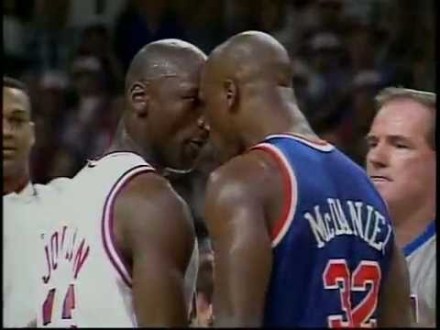
The Suns were fun to watch back then, but the Knicks had a particular appeal to me as well. My dislike for MJ and my respect for Pat Riley forced me to take notice of a budding rivalry growing between the two teams. When I watched the ’92 Eastern Conference Finals,

xavier-mcdaniel

it was the first time basketball had gotten my hyped about a matchup that wasn’t Cowboys-Niners. I liked that there was an actual team that would stand up to the Bulls and not be intimidated by his “airness.”

The 92 Knicks pushed the Bulls to the brink before they got their asses handed to them in game 6 of the ECF. The Bulls of course went on to beat the Suns in the Finals.

Xavier McDaniel had a cool name and looked cool, and the Knicks jerseys were dope (I also always wanted this T-shirt). I could fuck with these cats.

Now what did I know about basektball back then? Barely anything at all. But I couldn’t stand Jordan. He traveled and refs never called him for it. He was constantly palming the ball, and if you breathed on him, you got called for a foul.

Loving that era of Knicks basketball is akin to thinking about the girls I dated when I was a teenager. I didn’t know anything about romance, love, or basketball. I just went with what felt good (and what was convenient).

Knicks presented an alternative to what everyone else liked, so I went with it. There is no way I’d watch a team like that these days (Grit N’ Grind Grizz maybe the closest thing we have to those Knicks squads).

Compared to the free flowing movement, and teamball played in today’s era, those Knicks teams played mud ball. They were tough, physical, but watching them score was like trying to “squeeze blood from a turnip.”

Much like the Grit N’ Grind Grizzlies though, there were some characters on those squads. Even though I grew up loving the 80’s Hurricanes, Charlie Ward was a dude I respected, because he’d won a Heisman at Florida State, and he’d always given the Hurricanes the fits. The fact that he also was good enough to play professional basketball was very impressive (he, Bobby Sura, and Sam Cassell were the first 3 guard backcourt I’d ever seen).

Anthony Mason (R.I.P.) was like a left-handed poor man’s Boris Diaw, who always had a fresh cut. He was a big man who could handle the rock, was a great passer, and a good finisher at the rim.

starks-mason-knicks-300x260

John Starks had a bad ass commercial that will forever be a bond for me and my little brother. There was also of course this dunk that will forever be in the playoff pantheon of dunks.

A lot of people dug Patrick Ewing, but I was more into Oakley as a player. I’m not sure if I ever forgave him for not yamming that botched finger roll against the Pacers that would have given them a chance for the Conference title in 1995. Ewing was finesse, but Oakly was a rock, and the team enforcer.

Offensively he didn’t do a whole lot, but he was an underrated passer, and a pretty decent rebounder (though let’s be honest I didn’t know shit about rebounding back then).  What I liked most about Oakley though was that no one fucked with him. 2684052-9996374918-charl

The look on his face was enough of a veiled threat that only the biggest and baddest would dare to take him on. This of course was great theater to 15 year old me.

Greg Anthony, star point guard of the UNLV Running Rebels, was my dude. I feel like he didn’t get enough run in New York, but I suspect that it may have been because he was a defensive liablity. When he moved west to Portland, I instantly tuned into more Trailblazers games.

Another reason to root for the Knicks was that at one point, they had at least 3 former Dallas Mavericks on their squad: Derek Harper, Rolando Blackmon, Herb Williams, and even James Donaldson had a cup of coffee and an “Everything” bagel with Whitefish there in New York.

Of that group, Harper was the only one to really contribute anything offensively. “Ro” at this point was too old to get major run, although Herb Williams was decent enough to give 6 fouls as a big man (and as a teenager became code for scoring bud–like “Hey did ya’ll invite Herb Williams to come play pickup with us?”).

Poor Charles Smith will always be known for getting his cookies taken from him.

I was never what you would call a Knicks fan, but I rooted for them. In the summer of 1994, I was either watching a Knicks game, or a New York Rangers game, and I thought it was cool that the city of New York (which back then was still a bit of an absraction that I would never fully comprehend until my first visit there in 2000) could get two major championships within a week’s time span.

I was too removed to be more than mildly disappointed after each playoff loss (always under the weirdest circumstances too, remember this?). By the time they got to the post-lockout Finals, I was barely into sports at all (I affectionately call this period my “foggy” years).

NBA basketball is always more exciting when the Knicks are relevant, and its imperative that I visit Madison Square Garden for a Knicks game sometime in the near future.

The future is bright for Knicks fans. They seem to be moving int he right direction, and believe it or not, I trust in Phil. I hope they make the playoffs this year, and I hope they finally become serious contenders within the next 3-4 years. masonriley1

Though the 90’s Knicks never won a title, the fact that Pat Riley was able to build something worth rooting for is a testament to how brilliant he is. That team was not very talented at all, but everyone knew their role and worked with the skill set they posessed.

Pat Riley went from “Showtime Lakers” to the bruising style of basketball that epitomized what people thought of New York. Riley just worked with what he had, and it is no accident that the Van Gundy brothers (who worked with Riley) are renowned for their ability to get their teams to overachieve.

Only a fool would call them losers. They got the most out of their abilities and pushed every team they played to the brink. Knicks fans should be proud of those teams despite their perennial disappointing endings. They never laid down, and they always fought to the very end; which is all you can ever ask of any team that you root for.